
Why trace elements are the quiet factor behind a good lambing
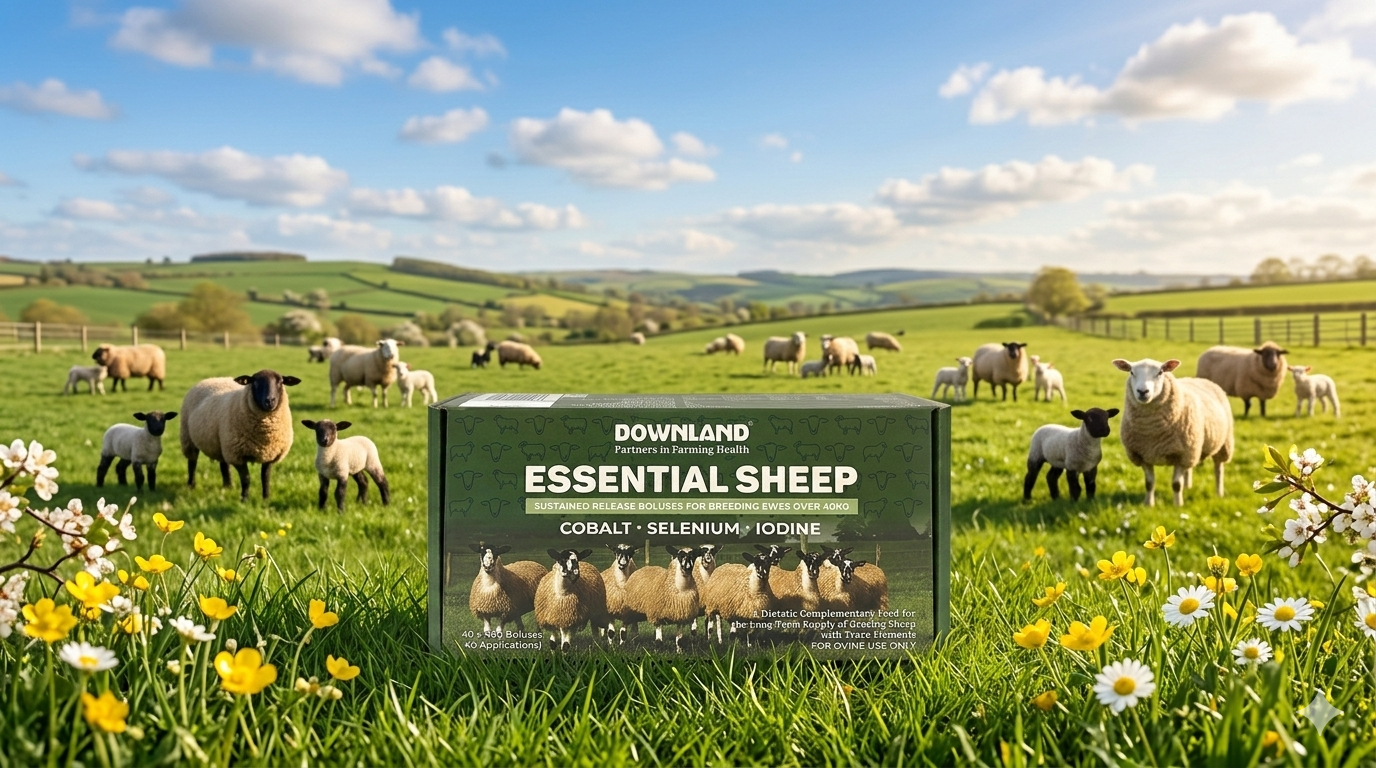
Downland Essential Sheep
Most sheep farmers don’t lose sleep over trace elements. They’re invisible, they don’t clatter like machinery, and they don’t show up as a line on the feed invoice in quite the same way as concentrates. Yet, as reported in The Scottish Farmer, trace element deficiencies continue to be one of the most frequent diagnoses in sheep submissions year after year.
That should give us pause. Not because farmers aren’t doing their job—but because nature is quietly stacking the odds against you.
The problem isn’t effort. It’s uncertainty.
Around 75% of foetal growth happens in the final six weeks of pregnancy. At exactly the point when ewes are under the most pressure, we’re often relying on forage whose mineral content we hope is doing the job.
But forage doesn’t read textbooks.
Soil type, compaction, waterlogging and pH all influence whether minerals like selenium and cobalt are actually available to the ewe. Two fields that look identical can deliver very different nutritional outcomes. The result? Lambs that should have thrived but didn’t. Ewes that should have coped but struggled.
No drama. Just disappointing margins.
Selenium and cobalt: small inputs, big consequences
Selenium plays a critical role in ewe immunity and lamb vigour. Deficiency has been linked to weak lambs, stillbirths and poor thrive—outcomes no farmer accepts lightly.
Cobalt is just as important, though less visible. It allows rumen microbes to produce vitamin B12, which underpins fibre digestion and energy metabolism. When B12 is short, ewes simply can’t get the full value from the forage in front of them—no matter how good it looks on paper.
In other words: you can’t feed your way out of a trace element deficiency with energy alone.
Why “doing nothing” is still a decision
There’s a useful behavioural insight here: most risk isn’t taken deliberately—it’s taken by default.
If mineral availability is variable and deficiencies are common, then relying on forage alone isn’t a neutral choice. It’s a gamble. Sometimes you win. Sometimes you don’t. But the cost of losing tends to show up at lambing, when it’s too late to fix.
That’s why targeted, long-acting supplementation has become part of many flock health plans—not as a blanket solution, but as insurance against known uncertainty.
A strategic approach, not guesswork
Products like the Downland Essential Sheep bolus are designed to provide a steady supply of key trace elements—including selenium, cobalt (for B12) and iodine—over an extended period. Used alongside blood testing and forage analysis, they help farmers correct deficiencies without over-supplementing, particularly important given selenium’s narrow safety margin.
This isn’t about adding more inputs. It’s about making existing inputs work harder.
The quiet wins matter most
Good lambings rarely make headlines. They’re calm, predictable and uneventful. And more often than not, that’s the result of small, unglamorous decisions made weeks earlier—decisions that remove friction rather than add complexity.
Trace elements may be invisible, but their impact isn’t. Getting them right won’t guarantee a perfect lambing—but ignoring them quietly increases the chance of disappointment.
And in farming, reducing avoidable risk is often the smartest gain of all.
What to do next
Protect your flock this lambing season:
Speak to your local McCaskie sales representative for tailored advice.
Visit your nearest McCaskie Country Store Ayr - Kinross - Lanark - Stirling to pick up the Essential Sheep 40 Bolus and other targeted trace element products.
Don’t leave lambing success to chance—take action now and give your ewes and lambs the support they deserve.