
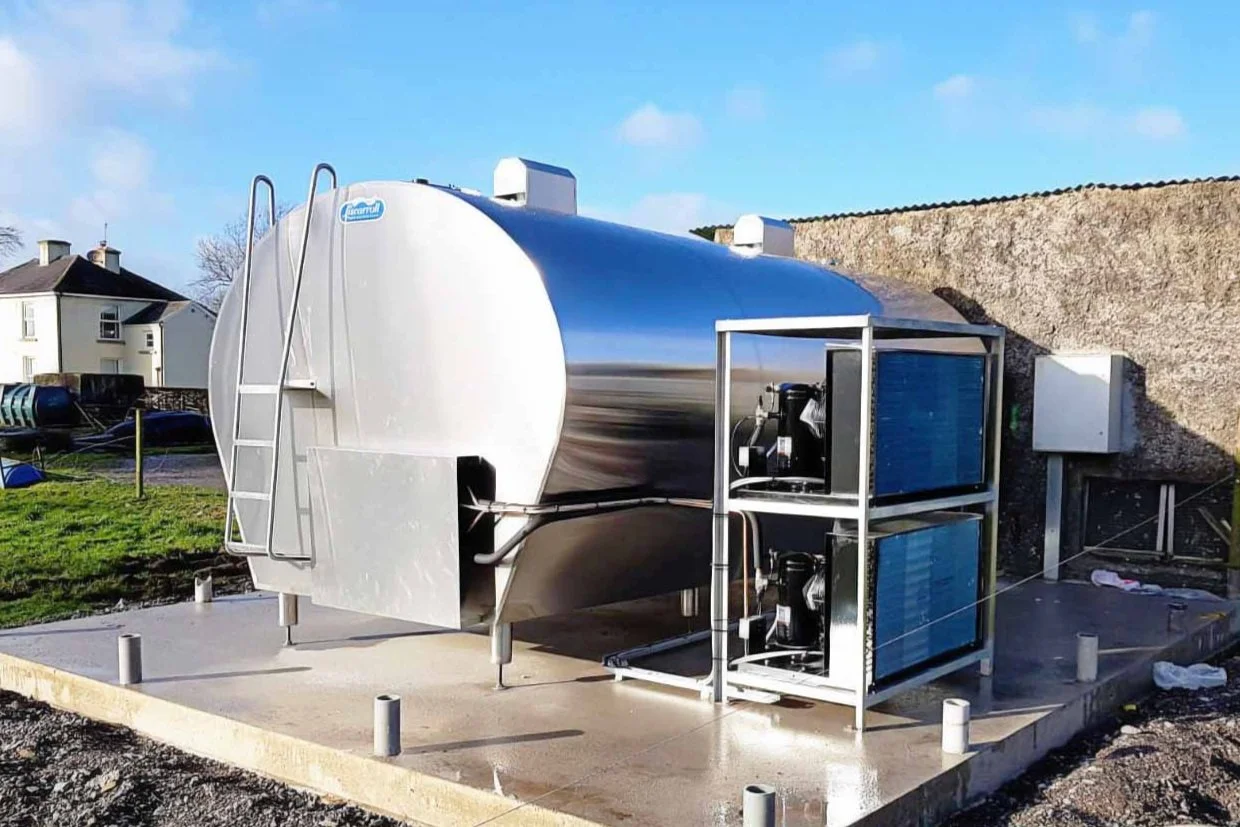
Milk Cooling and Storage
Bulk tanks, milk silos and cooling plant from Liscarroll — quoted, installed and serviced by our own engineers, from Stirling and Ayr.
Milk Is Cold Before It Is Anything Else
Every other thing you do well in the parlour is undone by a tank that will not pull the temperature down.
The requirement is not a buyer’s preference, it is the law. Raw milk must be cooled immediately to not more than 8°C where it is collected daily, or not more than 6°C where collection is not daily — Regulation (EC) No 853/2004, Annex III, Section IX, as retained in UK law. Miss it and the load is a conversation with your buyer rather than a tanker movement.
So a cooling system has two jobs, and they are different jobs. It has to pull heat out of warm milk fast enough at the end of a milking, and it has to hold what is already in the vessel at temperature without freezing it against the evaporator. Sizing for one and not the other is the most common reason a tank that looks big enough is not.
Tanks, Silos and the Plant Around Them
We quote it, we fit it, and the same engineers come back to service it. There is no third party between you and the people who installed it.
Bulk milk tanks
Horizontal and vertical stainless vessels for the milk you are producing now, sized against yield, milking interval and how often the tanker actually comes.
Milk silos
The vertical answer where the dairy cannot be extended — capacity goes up without the building footprint going up with it.
Direct expansion
Refrigerant evaporates in the tank wall and takes heat straight out of the milk. Simple, fewer moving parts, and the usual choice where electrical supply is not the limiting factor.
Ice bank
Cooling is banked as ice between milkings and spent quickly when the milk arrives. The answer where a fast pull-down is needed on a supply that will not carry the load in one hit.
Controls and washing
The LE-300 controller runs pre-configured one-touch wash programmes, with automatic or manual descale available. A tank is only as clean as the wash it actually completes.
Remote tank monitoring
Liscarroll’s independent tank monitoring system reports alerts by SMS, email and phone call, with daily temperature reports and remote access — so a rising tank is a message, not a discovery.
Pipework, pre-cooling, standing and the electrical side are part of the job rather than somebody else’s problem. We look at the dairy you have before anybody quotes a vessel for it.
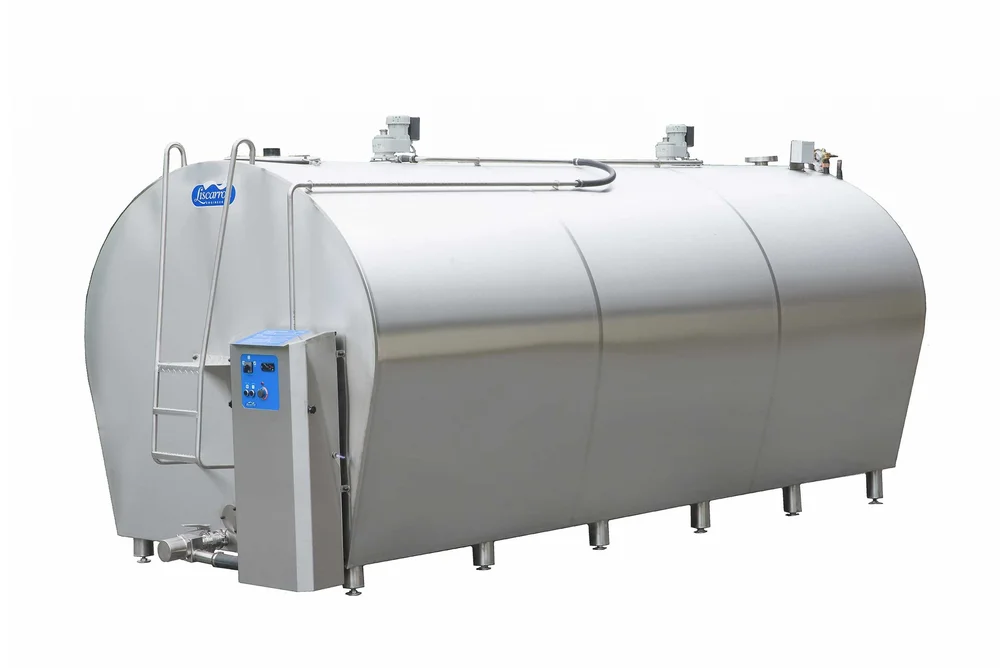
Liscarroll, Built in Cork Since 1973
Stainless steel and liquid cooling engineering, and the tanks on Scottish farms we have fitted them to.
Liscarroll Engineering have been building stainless steel vessels in County Cork since 1973. In their own words the tanks are “built by coded welders in Cork” and installed across Ireland, the UK and worldwide. Dairy is one of four sectors they fabricate for — the others are food and beverage, leisure and pharmaceutical — which is the reason the standard of welding on a milk tank is what it is.
Their published specification is worth reading rather than taking on trust. Between the inner and outer vessels the silos carry high density polyurethane foamed insulation up to 200mm thick, which is what keeps a full vessel at temperature overnight without the refrigeration cutting in repeatedly. Cooling is by Copeland Scroll compressor, with thermostatic expansion valves and a pump-down system on the direct expansion tanks. The evaporators cool from the base and the sides, and the wash and cooling controls sit together in a stainless alcove.
We will not repeat a manufacturer’s adjectives back at you. The specification is on the record, and the engineers who come and service the tank are ours.
Forty Thousand Litres, in Stirlingshire
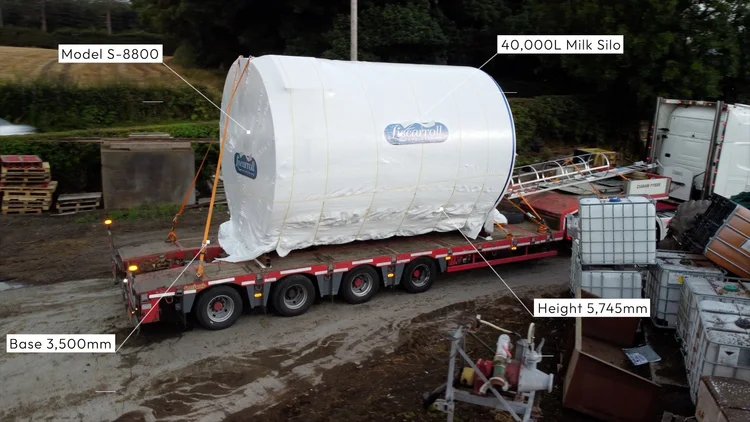
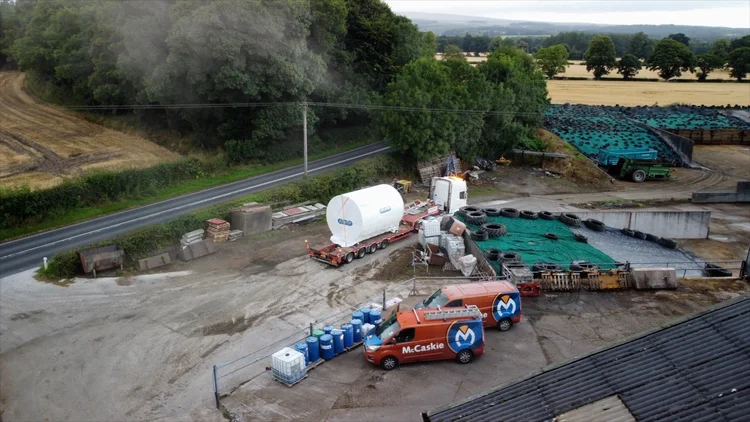
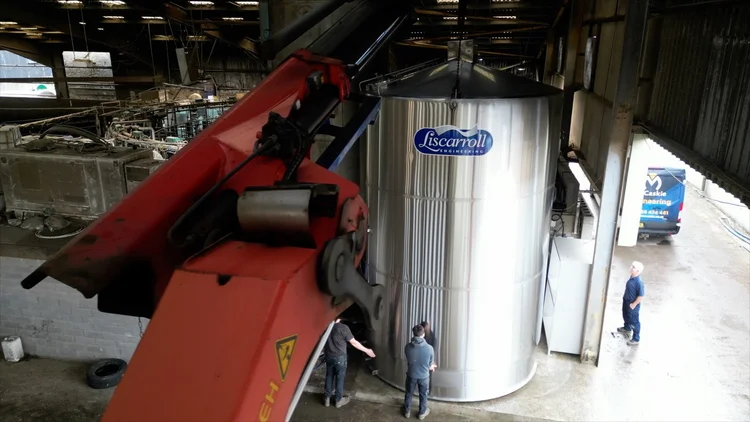
The largest of these we have put in is a 40,000 litre Liscarroll direct expansion milk silo, installed on a Stirlingshire farm by McCaskie engineers. The film alongside is ours, shot on the day.
A silo at that capacity is not a bigger tank so much as a different job. It arrived on a low-loader, 5,745mm tall on a 3,500mm base, and it goes in vertically — which is exactly the point, because the herd grows and the dairy does not have to. The work is as much about the standing, the pipework runs and access for the tanker as it is about the vessel itself, and it is the part a supplier shipping a tank to your yard does not do for you.
A Tank That Keeps Up With a Robot
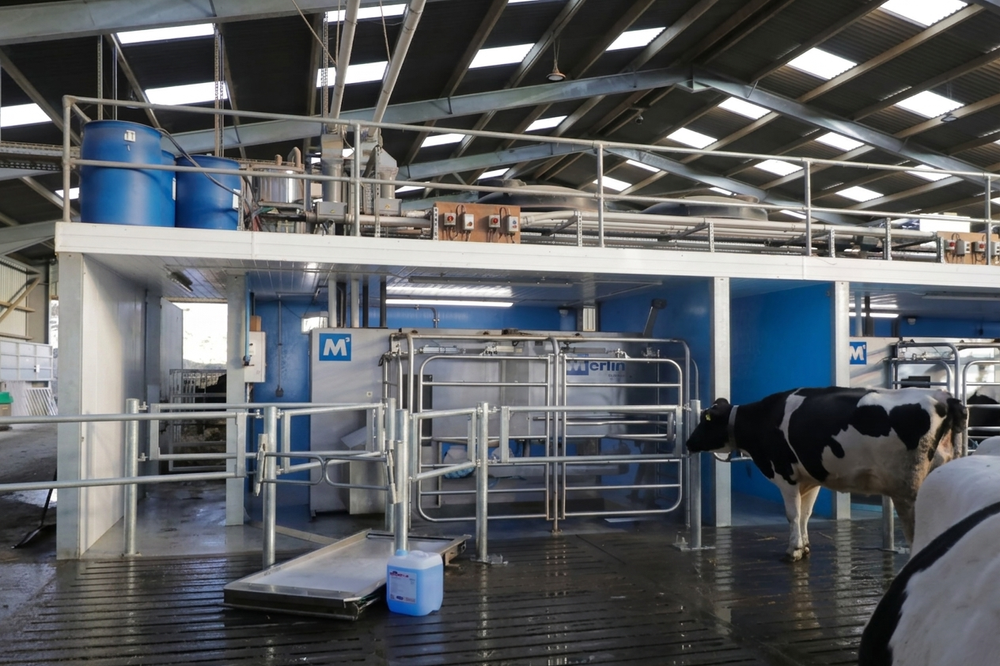
A robot milks around the clock, so the cooling behind it never gets the quiet hour a twice-a-day parlour gives it.
Milk arrives in small volumes all day and all night instead of in two surges, which changes how a vessel has to be sized and how the wash has to be timed around milkings that never stop. The LE-300 controller is robot milking compatible, and we set the two up to work together rather than leaving them to argue.
We are the leading Fullwood dealer in Scotland, with more than ten years behind us and more than 90 Merlin robots installed. If the cooling and the milking come from the same engineers, there is nobody to blame at four in the morning.
If We Installed It, We Look After It
Milk that will not cool is the same emergency as cows that cannot be milked, and it gets the same answer.
Cooling is covered by the same twenty-four hour, seven day call-out as every other machine we install. For everything short of an emergency — a quote, a site visit, a service booking, a part — there are two doors:
Ring Stirling
01786 474 481. The engineering office at Springkerse, Stirling. Ask about a machine, book a site visit, or order a part.
Email service
service@mccaskie.co.uk. For anything that can wait for a reply: a quote, a service booking, a question about a temperature reading.
Routine servicing is the half that pays for itself quietly: the wash proved, the controller checked, the readings written down so you can see them move. Out of hours, the call is forwarded to the technician on call — how that works, and who answers, is on service and call-out.
Milk Cooling Questions
What temperature does milk have to be cooled to on farm?
Raw milk must be cooled immediately to not more than 8°C where it is collected daily, or not more than 6°C where collection is not daily. That is Regulation (EC) No 853/2004, Annex III, Section IX, as retained in UK law. There is a narrow exception where milk is processed within two hours of milking.
Do you install milk tanks in Scotland?
Yes. McCaskie supply, install and service Liscarroll milk tanks, silos and cooling plant anywhere in Scotland, from our engineering base at Springkerse in Stirling and our second service centre at Ayr. Eight engineers do the fitting and the servicing.
What is the difference between direct expansion and ice bank cooling?
Direct expansion evaporates refrigerant in the tank wall and takes heat straight out of the milk as it arrives. An ice bank builds a store of ice between milkings and spends it quickly when milk comes in. Direct expansion is simpler and usually the first choice; an ice bank suits a farm needing a fast pull-down on an electrical supply that will not carry the whole load at once. We work out which on the farm, not on the phone.
Can a bulk milk tank work with a robot?
Yes. The LE-300 controller fitted to these tanks is robot milking compatible. It matters more than it sounds, because a robot delivers milk in small volumes right through the night and the wash has to fit around milkings that never stop. We install both, so the cooling and the robot are set up together.
Can I be alerted if the tank temperature rises?
Yes. Liscarroll’s independent tank monitoring and management system sends alerts by SMS, email and phone call, produces daily temperature reports and can be reached remotely. A rising tank reaches you as a message rather than as a discovery in the morning.
Do you service a milk tank you did not install?
Our service and call-out covers the machinery we have installed. We would rather tell you that now than send somebody to learn on your farm at four in the morning. If you are thinking about replacing an ageing tank, that is a conversation worth having before it fails rather than after.
What size of milk tank do I need?
It depends on the milk you are producing, how far you expect the herd to go, and how often the tanker actually comes — a farm on every other day collection needs far more capacity than the same herd on daily collection. We would rather look at the dairy and the collection interval than quote a vessel off a herd number.
What happens if the tank fails at the weekend?
Ring Stirling on 01786 474 481. Out of hours the call is forwarded to the technician on call — one of our own engineers. Cooling is covered by the same twenty-four hour, seven day, 365 day call-out as the milking plant.