
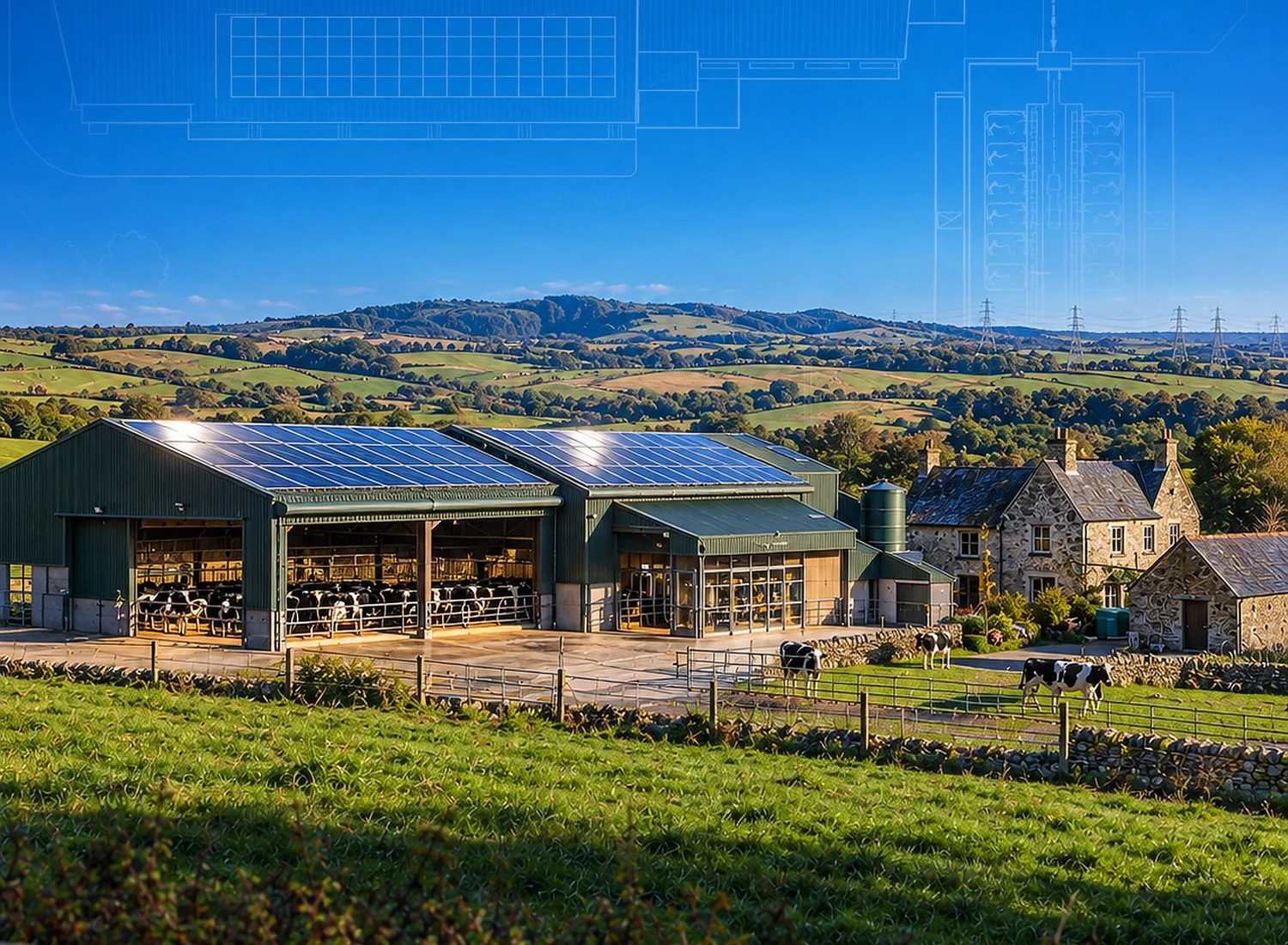
Energy Solutions for Scottish Farms
Your farm›Your plan›Your powerMake your own power, use it on the farm and keep the money in the business. Every system is specified from your farm's own meter data by independent energy consultants Beyond Innovation, designed and installed by PH Energy Systems, and arranged through McCaskie.
Power You Make, Use and Keep
Every farm uses electricity in its own daily pattern: milking and cooling on a dairy farm, lighting and ventilation in livestock sheds, grain drying at harvest, and the workshop and farmhouse all year round. You can't change when the farm needs power, and you have no say in what the grid charges for it.
Beyond the Grid changes the second part. The farm generates its own power, stores what it doesn't need straight away, and uses it where it matters most. The aim is a bill you can predict and a system you own.
It follows the same thinking as Beyond the Machine, our approach to robotic milking: the job doesn't start or stop with the kit. With energy, it starts with your farm's own numbers.
We Know Your Farm. We Bring the Experts.
You are not buying panels off a shelf. You are getting advice, a specification, a design and an installation, from three people who each do their part well.
Through McCaskie
We introduce you and stay involved from the first conversation to the finished system, with the farming know-how you already rely on.
Beyond Innovation
Independent energy consultants based in Girvan. They build your farm's energy profile and specify the ideal system from it. They are not tied to any manufacturer.
PH Energy Systems
Specialist microgrid engineers who design, build, install and maintain the ideal system for your farm.
Consultation requests go straight to Beyond Innovation, so from day one you are speaking to the people who will specify your ideal system.
Advice from People with Nothing to Sell
Beyond Innovation have spent more than 26 years designing and developing products for the renewables and energy sectors. They also built a training business that upskilled electricians moving into EV charging.
They work independently of any manufacturer or supplier, so the advice is not shaped by what someone needs to shift. Every option is weighed against your farm's own data: solar, wind, hydro, battery storage, and electric vehicles that can feed power back to the farm.
Farm energy is full of quotes that look good on paper. Independent advice is how you end up with a system that works on your farm.
- 26+ yearsdesigning for the renewables and energy sectors
- Independentof every manufacturer and supplier
- Your datais where every design starts
Use It, Don't Sell It
It's tempting to treat spare power as something to sell back to the grid. The numbers rarely work that way. Every unit you use on the farm saves the full price you would have paid for it. Every unit you export earns whatever the export tariff pays, which is usually a fraction of that.
Export tariffs can also be variable, so the return moves with the market and out of your hands. The saving on a unit you use yourself is fixed by what you no longer have to buy.
That is why a good design is sized to what your farm uses and when, with battery storage to move daytime generation into the evening and the overnight load. Exporting is what happens to the surplus. It should never be the plan.
Make it, use it, keep the saving.
Buying Power vs Selling It
Pence per kWh, UK, 2026
A System That Grows with the Farm
You don't have to do everything at once. Start with whatever pays back first on your farm, then build on it as the business changes: more generation, more storage, a new shed, an electric vehicle. Each system is designed so it can be added to without starting again.
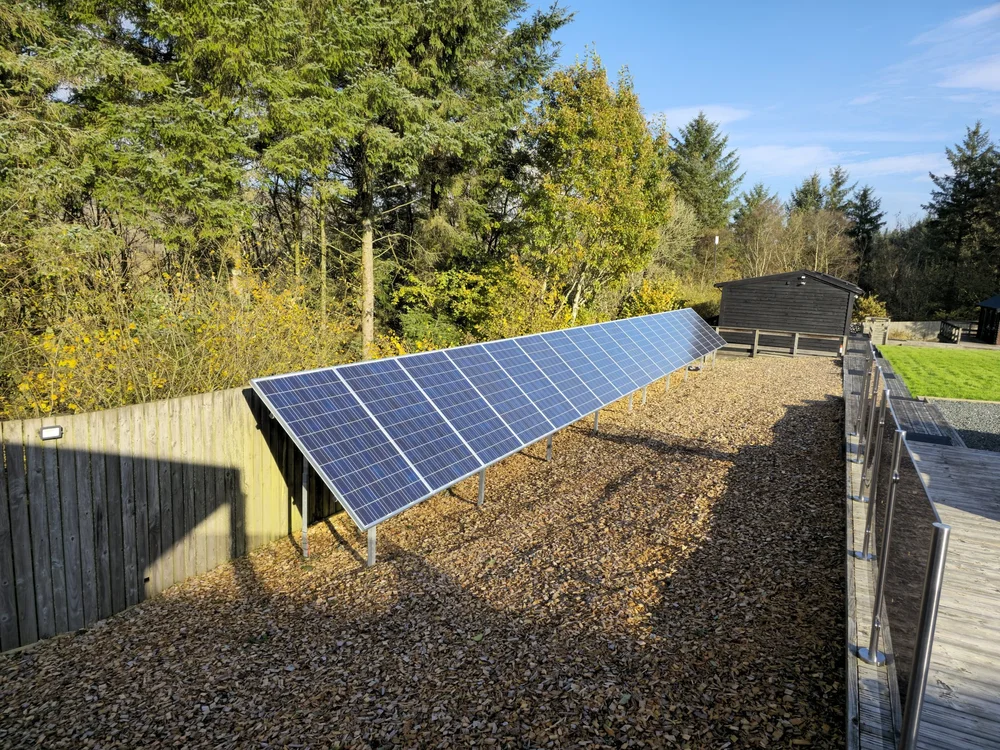
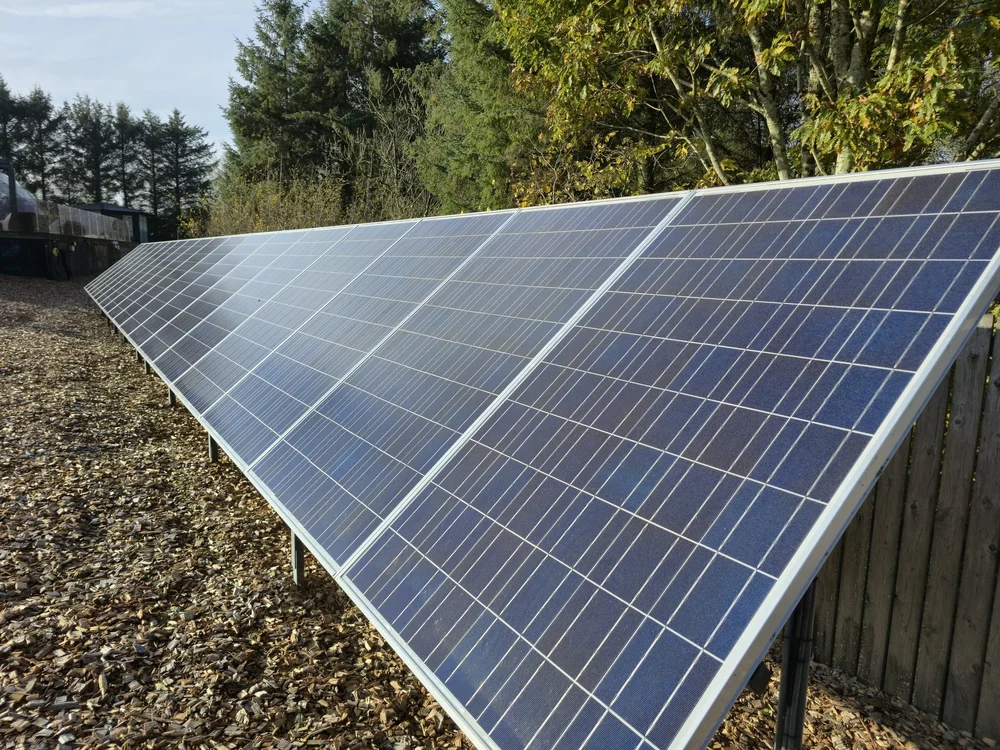
Ground-mounted solar: panels on their own frame, set at the angle that suits the site.
Generate
Solar, wind or hydro, chosen to suit your site and when your farm uses power.
Store
Batteries that hold power made during the day for the evening and the night.
Control
A microgrid that decides where each unit goes: the parlour, the sheds, the grain dryer, the battery or the grid.
Expand
Add capacity as you grow, including electric vehicles that can feed power back to the farm.
As Independent of the Grid as You Want to Be
Every farm wants something different from its energy system. Beyond Innovation start by finding out which of these matters most to you:
- A lower bill you can budget for
- Keeping the farm running when the power goes off
- Getting as close to off-grid as your farm can go
Then they tell you straight what your farm can realistically achieve.
The Battery Behind the System
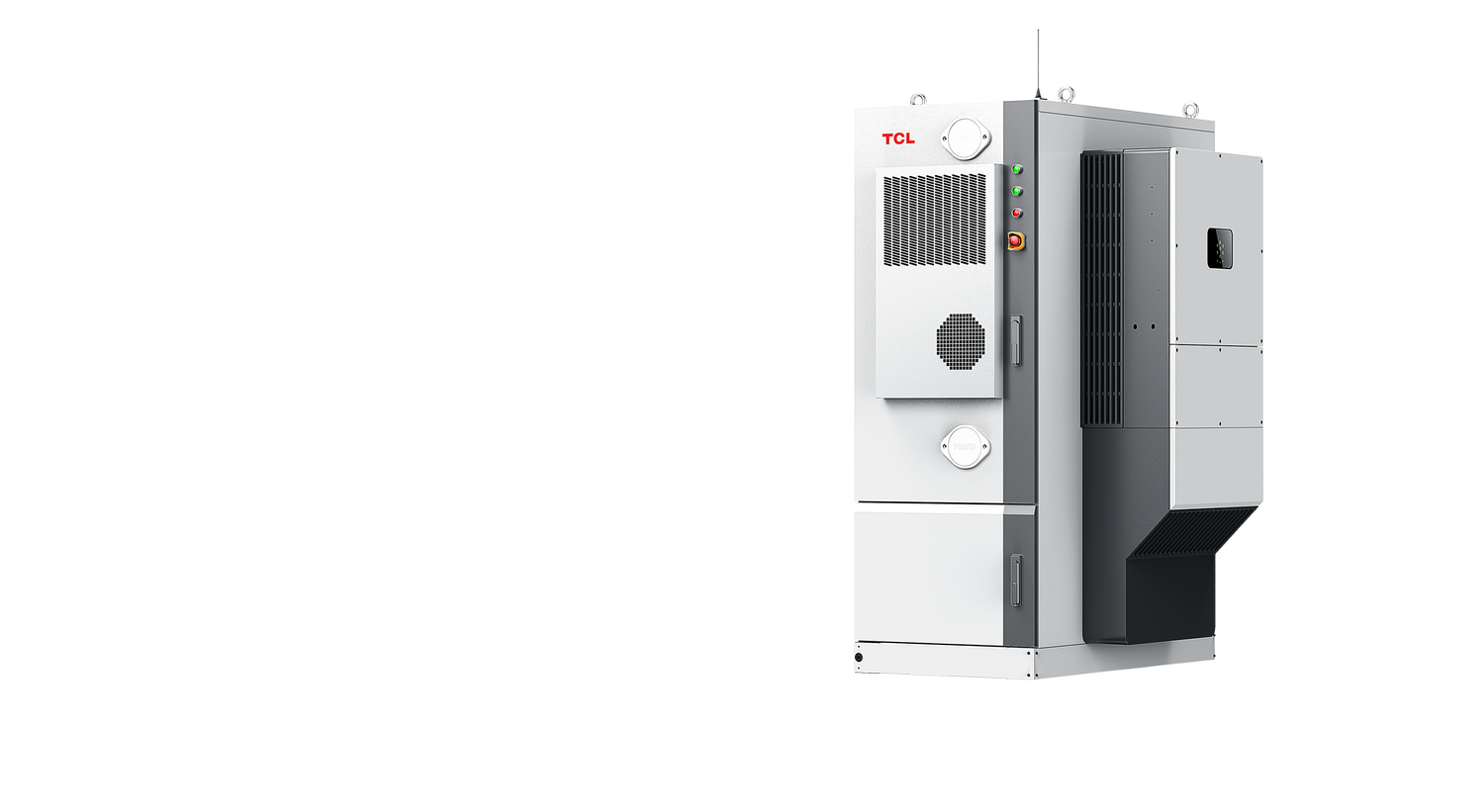
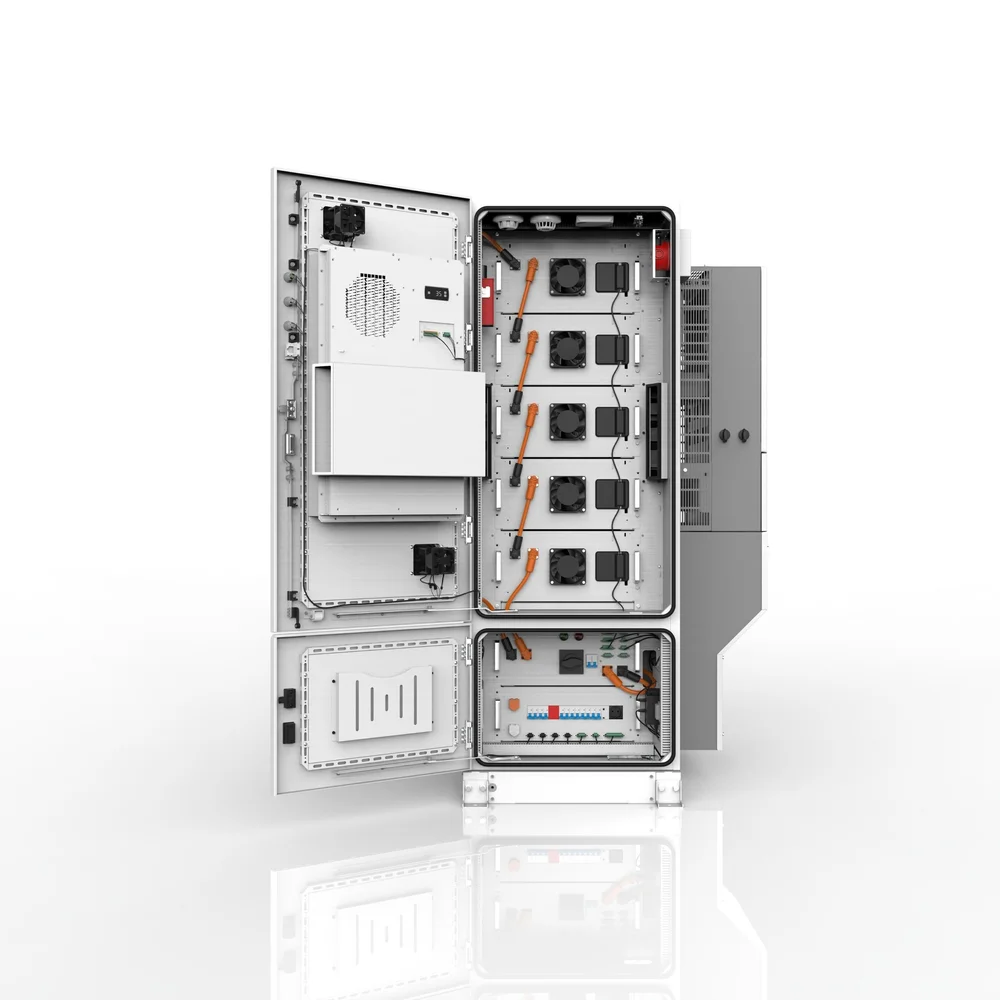
Where an all-in-one battery suits the farm, PH Energy Systems use the TCL X5. It is one outdoor cabinet holding the battery, a 50 kW three-phase hybrid inverter, the switching and its own fire protection, all assembled and wired at the factory.
Why It Suits a Farm
- Power stays on when the grid goes off. It switches the farm over to the battery in under 20 milliseconds, and it can start itself up again with no grid and no solar.
- It works with your generator. A standby generator can be connected to it too.
- It stores your own solar. Six solar inputs take up to 100 kWp of panels, so power made during the day is still there in the evening and overnight.
- It grows with the farm. Battery capacity can be added to the same unit, and up to ten units can run together.
- It is built for outdoors. Rated IP55 against dust and rain, it runs from −30°C to 50°C.
- Lithium iron phosphate cells, with gas detection and fire suppression built into the cabinet.
- 50 kWhybrid inverter, three-phase 400 V
- 100 kWhof battery to start, expandable to 400 kWh
- <20 msto switch to battery in a power cut
- 1.35 m²floor space for the whole cabinet

The TCL W10
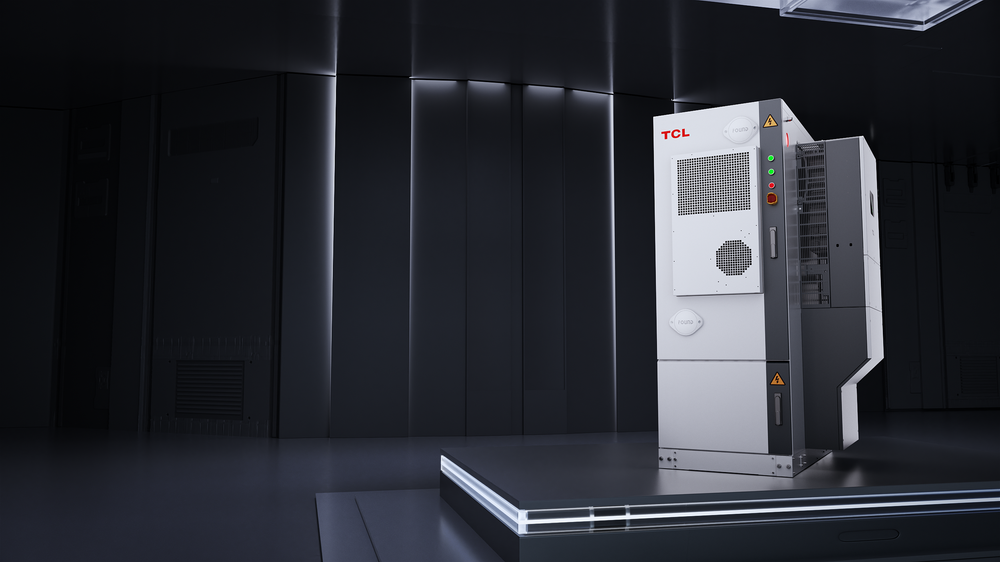
Where a farm needs more than the TCL X5 can give, PH Energy Systems use its bigger brother, the TCL W10. It is one outdoor cabinet holding 261 kWh of battery and a 125 kW three-phase inverter, cooled by liquid, and it can be built up to 6.3 MWh. It runs connected to the grid or off grid, and is designed to hold a steady output on a weak supply and balance the three phases.
It has the same safety thinking as the X5: lithium iron phosphate cells, gas detection and aerosol fire suppression, rated IP55 and working from −30°C to 50°C.
- 125 kWinverter, three-phase 400 V
- 261 kWhper cabinet, expandable to 6.3 MWh
- 8,000cycles, still holding 70% of its capacity
- 1.35 m²floor space, about 2.7 tonnes
Whether your farm needs a battery, and what size, comes out of your energy profile. It is one of the first things Beyond Innovation look at. Book a free consultation
Specifications from TCL's published TCL X5 and W10 data. Photographs: TCL.
Victron: A Microgrid Built Around the Farm
Where a farm needs a system built to its own shape rather than a factory cabinet, Beyond Innovation specify a microgrid using Victron Energy equipment instead. Victron is a Dutch company that has spent decades building inverters and battery systems for boats, remote sites and off-grid homes, where the power cannot be allowed to fail.
Because Victron is an open system, each part is chosen and sized for your farm rather than bought as one fixed box.
What It Can Do on a Farm
- Grows with the farm. Units link together, from a small single-phase system up to large three-phase installations, so it can expand as more machinery and vehicles go electric.
- Three-phase from a single-phase supply. It can be set up to give a farm three-phase power where the grid only brings single-phase, which can save the cost of upgrading the connection.
- Makes a weak supply go further. It blends power from the grid or a generator with the battery to carry heavy peak loads the supply could not manage alone.
- Buys power when it is cheap. On a suitable tariff, it charges the battery when grid prices are low and uses or sells the stored power when they peak.
- Works with the kit you choose. It runs with a range of lithium battery makes, generators, wind and existing solar inverters.
- Runs off grid if it has to. The same system can keep the farm going on its own power when the grid goes down.
- Free monitoring. Live and past data on Victron’s VRM portal and app, with no monthly subscription, which Beyond Innovation and PH Energy Systems both use to tune the system and plan what comes next.
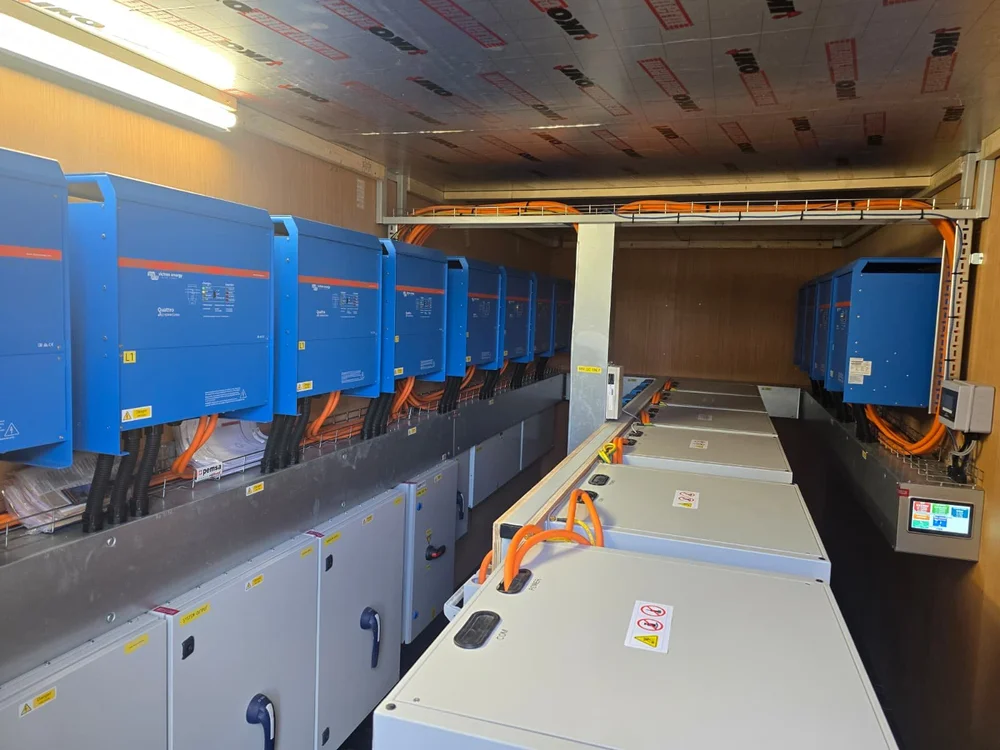
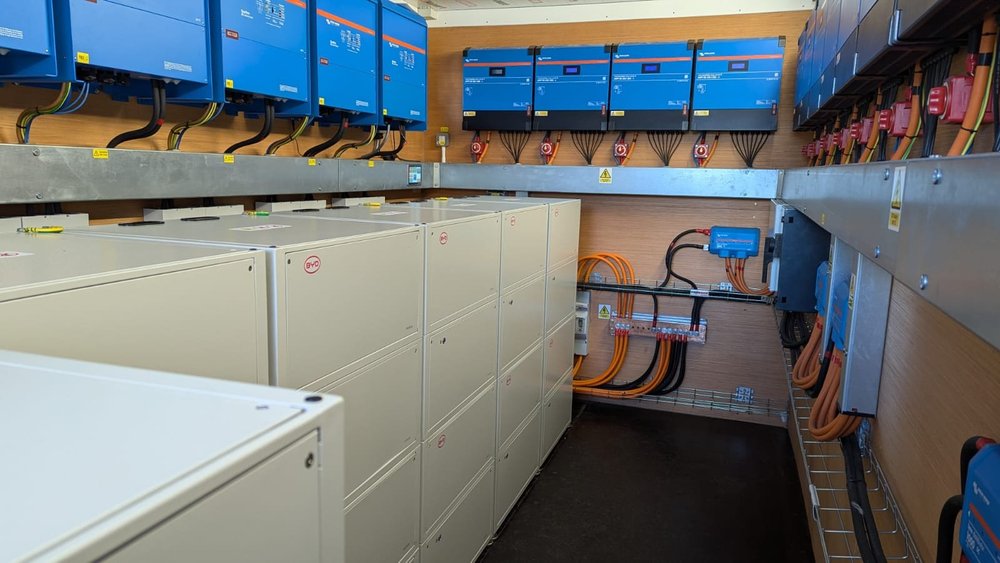
A Victron microgrid specified by Beyond Innovation and built, installed and maintained by PH Energy Systems: the inverters along the walls, the battery cabinets on the floor.
TCL X5 All-in-One Cabinet
- Battery, inverter, switching and fire protection in one outdoor cabinet
- 50 kW, with 100 to 400 kWh of battery per cabinet
- Suits a three-phase farm that wants a factory-built unit
TCL W10 Large Cabinet
- The same all-in-one idea, built for bigger loads
- 125 kW, with 261 kWh per cabinet, expandable to 6.3 MWh
- Suits larger farms that want a factory-built unit
Victron Microgrid
- Specified and built part by part around the farm, any size
- Single or three-phase, including three-phase from a single-phase supply
- Suits farms with a weak supply, big peak loads or plans to go off grid
Which one suits your farm comes out of your energy profile, and Beyond Innovation will tell you straight. Book a free consultation
Ask Before You Install
Whoever you speak to about farm energy, ask these ten questions before you sign anything. A good designer will be glad you did, and the answers will show you quickly who has looked at your farm and who is reading from a brochure.
Has anyone looked at my meter data?
A system should be sized from when your farm uses power, not from the size of the roof.
Where should the panels go for my farm's busy times?
The sunniest roof isn't always the right one. Panels facing east and west can match early and late demand, such as morning and evening milking.
Will my roof or ground take it?
Check the structure, and look for anything that shades the panels in winter when the sun is low.
Will it trip on high voltage?
On long rural lines, exporting can push the local voltage up until the inverter's protection disconnects it. Repeated tripping is a design or settings fault to fix, not bad luck.
Is the DNO application sorted?
The network operator has to approve the connection and may limit what you export. An approved export limitation scheme can let a bigger system go in.
How will the batteries charge?
From your own generation first, from cheaper overnight power, or both. The wrong strategy wastes the battery.
How much will I use, and how much will I export?
Every unit you use saves the full price. Every unit you export earns a fraction of it.
Can I add to it later?
More generation, more storage or an EV should not mean starting again.
Is whoever specifies the system paid to sell kit?
Independent advice means the specification is sized to your farm, not to a sales target.
Who looks after it once it's in?
Know who you phone when it stops, before it is installed.
Save this list for the next time someone rings about solar, or ask Beyond Innovation all ten at a free consultation.
From Energy Profile to Installation
Build Your Energy Profile
A detailed look at when the farm uses power, where demand peaks, and how the cost builds up across the day, the week and the year.
Specify the System
Beyond Innovation specify a system from that profile, using the technologies that suit your farm, aimed at stability, efficiency and long-term value.
Design, Build and Install
Specialist microgrid engineers PH Energy Systems design, build and fit it on your farm, managing the project throughout.
McCaskie Stays Involved
We remain your first point of contact, from the first conversation to the finished system.
Farm Energy Questions
Who designs and installs a farm energy system through McCaskie?
Independent energy consultants Beyond Innovation specify the system from your farm's energy profile. Specialist microgrid engineers PH Energy Systems design, build and install it. McCaskie is your first point of contact and stays involved throughout.
Is the energy consultation free?
Yes. The first consultation is free and without obligation. Beyond Innovation look at how your farm uses power and talk you through practical options.
Is it better to sell solar power back to the grid or use it on the farm?
Using it on the farm is almost always worth more. Each unit you use saves the full price you would have paid to buy it, while export tariffs usually pay a fraction of that and can change with the market.
What can a farm energy system include?
It depends on the farm. Beyond Innovation consider solar, wind, hydro, battery storage, microgrid control and electric vehicles that can feed power back, and recommend only what suits your energy profile.
Why do solar systems trip out on farms?
On long rural lines, exporting can push the local voltage above the limit the inverter's protection allows, so it disconnects. It is usually a design or settings problem, and it should be checked for before a system is installed.
What battery is used for farm energy storage?
It depends on the farm. Where an all-in-one battery suits, the TCL X5 is used: one outdoor cabinet holding the battery, a 50 kW three-phase hybrid inverter and its own fire protection, starting at 100 kWh. For bigger loads, the TCL W10 holds 261 kWh with a 125 kW inverter in one cabinet, and can be expanded to 6.3 MWh. Where a farm needs a system built to its own shape, a microgrid is designed on Victron Energy equipment, which works with a range of battery makes.
What happens to the farm in a power cut?
With a TCL X5 or a Victron microgrid, the farm can switch from the grid to the battery in under 20 milliseconds, fast enough to keep essential loads running. The TCL X5 can also draw on a standby generator and start itself up again with no grid and no solar. Which circuits stay on is decided when the system is specified and designed.
How much solar can the battery take?
The TCL X5 takes up to 100 kWp of solar panels, twice the rating of its 50 kW inverter, across six separate solar inputs. Roofs facing different ways can each go on their own input, so more of the farm's roof space can be put to use. With a Victron microgrid, a much larger solar array can be installed to suit the farm's needs.
How much space does a farm battery need?
The TCL X5 cabinet stands on 1.35 square metres. The battery, inverter, switching and fire protection are all in that one cabinet, and it is built to stand outdoors. The larger TCL W10 stands on the same 1.35 square metres but weighs about 2.7 tonnes. Victron microgrids are usually installed in an ISO shipping container, as a self-contained power plant for the farm.
How safe is the TCL X5 battery?
It uses lithium iron phosphate cells, and the cabinet has its own battery cooling, gas detection and aerosol fire suppression built in. It is rated IP55 against dust and water and C3 to C4 for corrosion resistance. TCL's published warranty is five years.
What is a Victron microgrid?
A farm energy system built from Victron Energy inverters, chargers and controls, each chosen and sized for the farm. It can combine the grid, solar, wind, a generator and batteries, run on single or three-phase, and keep going off grid if the grid goes down. Beyond Innovation create the system specification, and PH Energy Systems design, build and install it.
Can a farm get three-phase power from a single-phase supply?
Often, yes. A Victron system can be set up to supply three-phase power on a farm that only has a single-phase connection, which can save the cost of upgrading the supply. It suits some loads better than others, so Beyond Innovation will tell you whether it works for your farm.
Can a farm battery charge from cheap grid power?
Yes. A Victron system can charge the battery when grid prices are low and use or sell the stored power when they peak. It needs a suitable time-of-use or dynamic tariff, and the system is set up to match yours.
Can I check my farm energy system from my phone?
With a Victron system, yes. It reports to Victron's VRM portal and app, which are free with no monthly subscription, and show live and past data. Beyond Innovation and PH Energy Systems both use the same data to tune the system and plan any expansion.
Can a farm go completely off grid?
Some can get close, depending on demand, generation and storage. Beyond Innovation will tell you what is realistic for your farm once they have seen your data.
Can I add to the system later?
Yes. Systems are designed so you can add generation, storage or electric vehicles as the farm changes, without starting again. With the TCL X5, one cabinet can grow from 100 kWh to 400 kWh of battery, and up to ten cabinets can run together, up to 500 kW and 1 MWh. The TCL W10 can be built up from 261 kWh to 6.3 MWh. A Victron microgrid can be extended much further still, a unit at a time, for even more long-term flexibility.
Book a Free Energy Consultation
The consultation is free and without obligation. Tell us a little about the farm and Beyond Innovation will look at how you use power and talk you through practical options. No sales pressure, just clear advice from people who understand farming.
Fill in the form below and Beyond Innovation will be in touch.