
Ventilation and Cooling for Livestock Buildings
We come and look at the shed, work out what the air is actually doing in it, and fit the system that fixes it — fans, ventilation tubes, controls and the wiring to go with them. Installed and serviced by our own engineers, right across Scotland.
You Cannot Fix a Shed From a Bottle
A cough that comes back every winter in the same pen, calves that scour and never quite thrive, milkers that go off their feed in July — the shed is usually doing that, not the bug. Air is the cheapest input on the farm and the easiest one to get wrong, because you cannot see it and nobody sends you an invoice for it.
Natural ventilation works until the day there is no wind. Then a low, long, sheltered building holds its own stale air at stock height, and everything you spend at the counter is working against the building.
Four Sheds, Four Different Problems
Pneumonia That Comes Back
Same pen, same time every year. Usually air sitting still at calf height rather than anything you can treat your way out of.
Heat Stress in the Milkers
Intakes fall before yield does. A still, humid July in a cubicle shed is harder on a Holstein than most people expect.
A Shed With No Wind In It
Long, low, and tucked in behind a bank or a belt of trees. It ventilates beautifully on a breezy day and not at all on a calm one.
Grain Going In Warm
Store temperature and moisture that will not come down, and a crop that will not hold until you want to sell it.
Fresh Air Where the Young Stock Actually Are
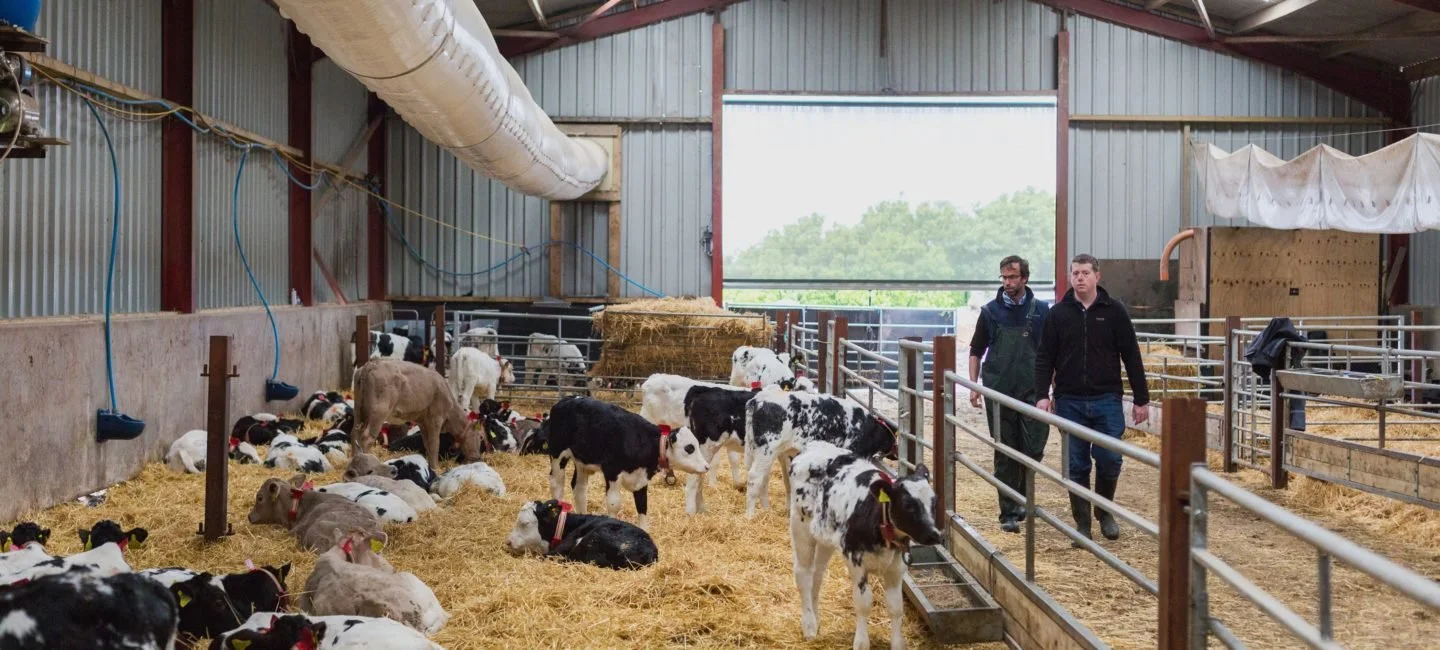
A plastic duct run above head height the length of the building, with sized openings along it, pushing a steady supply of clean air down to the pens.
The tube is fitted above animal height and the openings are sized and positioned for the building, so the air arrives evenly the whole way down rather than blasting the first pen and never reaching the last. That is positive air movement: the building is given fresh air instead of being asked to find its own, and it keeps doing it whether or not there is any wind outside.
What it is really doing is dilution. Airborne pathogens and irritants get thinned out and carried away before they build up at nose height. It is the system we reach for most often in calf sheds and in low buildings where natural ventilation has run out of ideas — and it is a fan-and-duct job, so it wants sizing against your building rather than picking off a list.
Moving Air in a Big Span
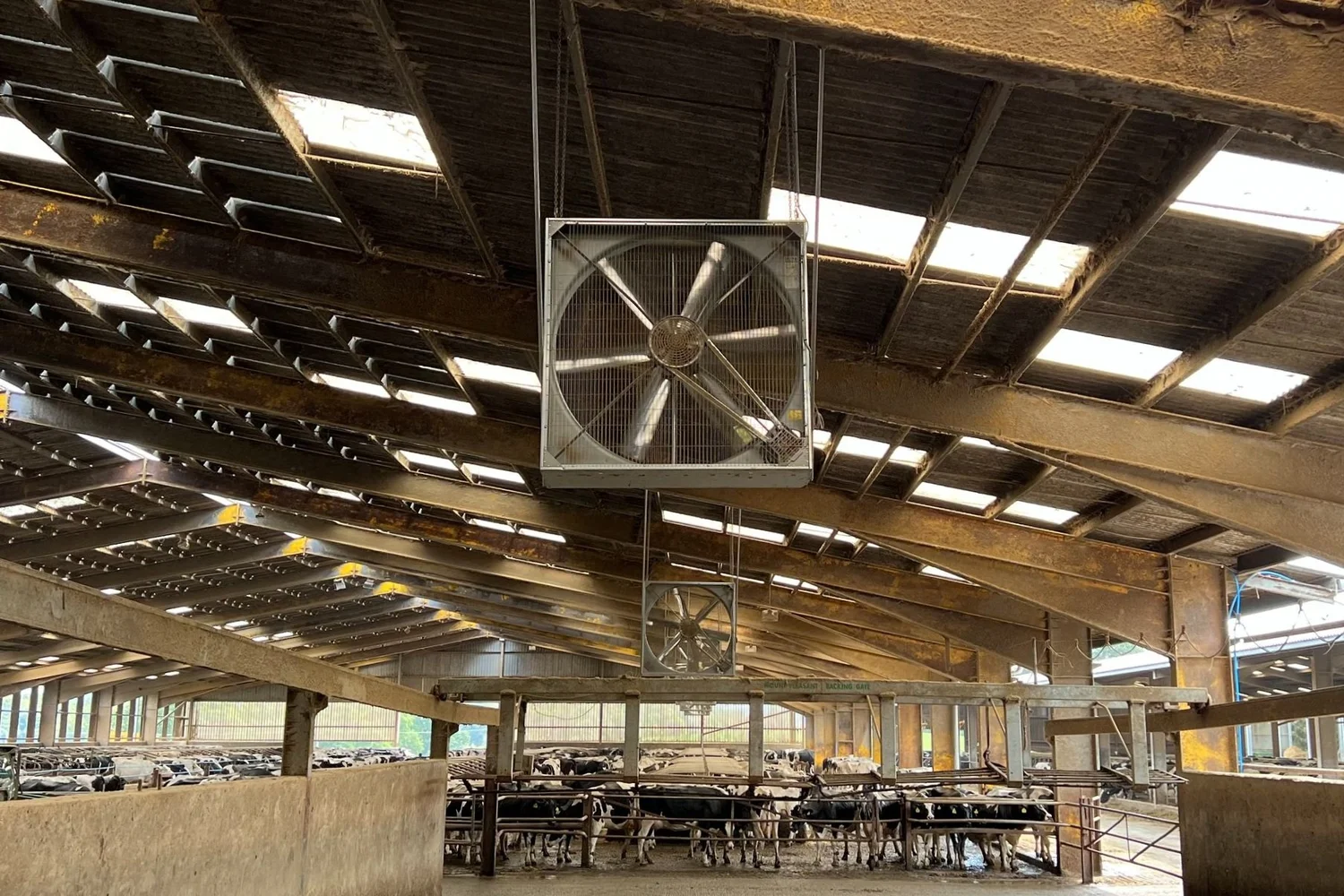
Where the building is too big or too still for a duct to do it on its own, the answer is usually a bank of high-volume belt-drive fans.
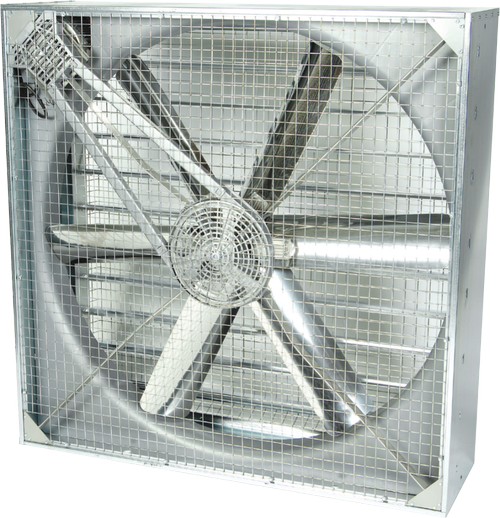
They shift a lot of air at low pressure for very little power. Galvanised steel housings, stainless steel impellers and sealed-for-life bearings, rated IP55 and to 50°C, and they arrive fully assembled with guards inside and out or a centrifugal backdraught shutter on the outside face.
Five sizes, from 800mm to 2000mm, in three mountings: on the wall with shutters, hung from the roof space, or floor-standing on wheels for a shed where the problem moves about. Single or three phase, with louvre and guard options to suit. Which size and how many is a survey question, not a catalogue one.
Which System Does Which Job
| System | What it fixes | Where it usually goes |
|---|---|---|
| Tube ventilation | Stale air at stock height; pneumonia pressure in young stock | Calf sheds and low buildings with poor natural airflow |
| Belt-drive fans | Standing air and heat stress over a big floor area | Cubicle sheds, collecting yards, wide spans |
| Circulating and destratification fans | Warm air sitting up in the roof while the stock are cold | Tall buildings and anywhere the heat is in the wrong place |
| Roof and chimney fans | Getting stale air out at the ridge | Enclosed and poultry housing |
| Plate and side wall fans | Extraction through a wall or panel | Poultry houses and smaller enclosed buildings |
| Grain pedestal fans | Temperature and moisture in store | Grain stores |
What We Can Put In
We fit the Elta agricultural range, which is the Hydor range you already know — it rebranded, the fans did not change, and it is still made in Britain at Salisbury.
- Belt drive — Agri-Drive HV Wall, HV Hanging and HV Mobile.
- Roof and chimney — Agri-Jet HXRU and the Agri-Max HAF, HAF EC and HAF XL, in three or four arm designs, AC or EC motors, and ridge angles cut to the building.
- Plate — Agri HXP, Agri HXP EC and the Agri HEB replacement unit, 250mm to 800mm across twenty-four models.
- Circulating — Turbulator HTS and HTS EC, Turbulator Lite HTSP, and the D-Mix HDSF and HIDSF destratification fans.
- Side wall — Easi-Fit HXSU.
- Grain — Centri-Grain HGD pedestal fans.
If the building needs curtains, doors or sheeting rather than fans, that is weather protection and it is the next page along. Plenty of sheds need a bit of both.
Questions We Get Asked
Do you fit it, or do I just buy the fans?
We fit it. A job starts with an engineer coming out to look at the building, and ends with the system installed, wired and running. We service what we fit as well.
How do you decide what my shed needs?
By standing in it. Building shape, roof height, what is upwind of it, what stock is in it and at what age, and where the air is actually sitting on a still day. Two sheds on the same farm often want different answers.
Will fans stop my calves getting pneumonia?
Ventilation changes the pressure the calves are under — it dilutes and clears the air they are breathing instead of leaving it to build up. It works alongside your vet and your health plan, not instead of them.
What is the difference between a fan and a ventilation tube?
A fan moves the air that is already in the building about. A tube brings fresh air in and spreads it evenly down the length of the shed. Big open spans usually want fans; calf sheds and low buildings usually want a tube; some sheds want both.
Can you work in a shed that is full of stock?
Usually, yes, and most of our installs are in working buildings. We will tell you straight if a job needs the shed cleared or a quiet window.
Is this still Hydor?
Same fans, same factory — the Hydor range has rebranded to Elta. If you have Hydor units in the shed already we can still service them and match new kit to them.
Our engineers fitted a full HV belt-drive fan system at Meldrum Farm, Blairdrummond, and that is the way most of this work goes: look at the building, agree what it needs, fit it, come back and service it. The engineering department covers the whole of Scotland from Stirling, and there are counters at Ayr, Kinross, Lanark & Stirling if you would rather start by talking to somebody in person.
Ask for a shed survey, or call the engineering team on 01786 474 481. If it is a breakdown rather than a new install, that is service and call-out.