
Moocall Calving Sensors
A tail sensor that texts you before she calves — over the counter at four stores, or through your rep.
The Calving You Slept Through
Nobody loses a calf because they did not care. They lose it because it came at three in the morning and nobody knew.
A heifer that gets into trouble at two is a different outcome from a heifer that gets into trouble at two and somebody is there. That is the whole proposition, and it is worth being clear that it is about attendance rather than about calving itself. The sensor does not make a difficult calving easier. It makes it more likely that somebody is standing there when it happens.
Which is also the honest limit. If you are already checking every two hours through the night on a tight block, you are buying less than a farm where the cows are half a mile away and the house is asleep.
It Watches the Tail, Not the Cow
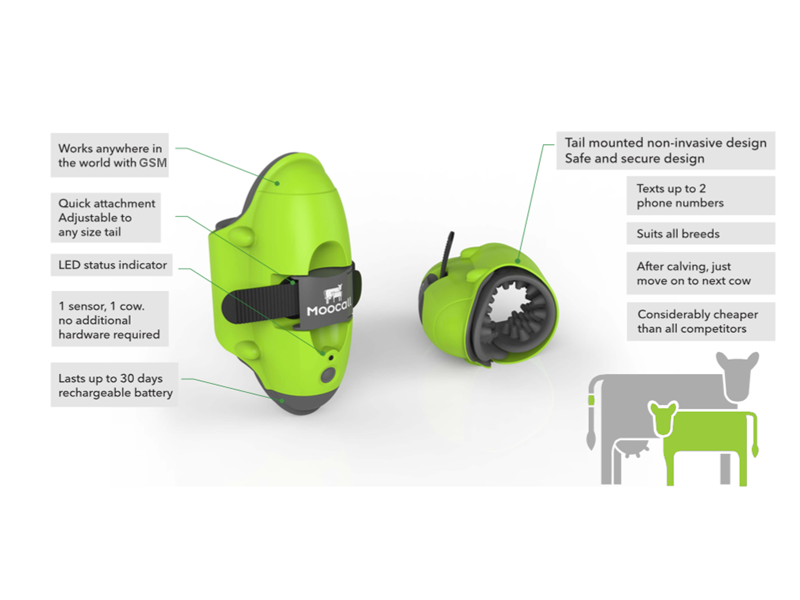
A sensor mounted on the tail that reads movement, and sends a text when the pattern changes.
Moocall describe it as a tail-mounted motion sensor that measures tail movement to predict the onset of calving. It goes on about a week before she is due, having been charged overnight and activated online, and it stays on until she calves.
When the pattern changes you get a text. Moocall say that after the first message you have on average one hour before the cow calves — their figure, and average is doing real work in that sentence. The unit uses embedded m2m technology rather than your own phone signal, and Moocall say it roams across 190 countries, which in practice means it hunts for whichever network is strongest rather than relying on the one you happen to be with.
That last point answers the question every Scottish farm asks first — what happens where there is no signal.
And Who It Does Not
Moocall publish a list of the cases it suits. It is a good list, and it is worth adding the other half.
Heifers
First calvers are where the trouble is, and they are the animals worth the unit if you only run one.
Night calvings
The case the product exists for. A text at three beats a discovery at six.
Distance
Where the cows are not within sight of the house. The further away they are, the more the sensor is worth.
Early and late calvers
The ones at the edges of the block, when the routine checks have either not started or already stopped.
Pedigree animals
Where the individual animal is worth a great deal more than the average and an hour of warning is cheap insurance.
What it is not
One sensor covers one cow at a time. A tight block-calving herd needs a plan for moving it between animals, or more than one unit — not one device and optimism.
It is a warning system and nothing more. It does not tell you whether she needs help, and it is no substitute for knowing your cows or for ringing your vet when something is wrong.
Counter or Rep
This is an ordinary retail line rather than an installation — you can carry it out of a shop.
The country stores
Ayr, Kinross, Lanark & Stirling. Ask at the counter; if it is not on the shelf it can be in within days.
Your sales rep
Eight reps across Scotland, every one a qualified SQP. They are on the farm anyway. Find yours.
Before calving starts
It needs activating online and charging overnight before it goes on a cow, so buying it the week you need it is cutting it fine.
Calving Sensor Questions
How does a Moocall calving sensor work?
It is a tail-mounted motion sensor. Moocall describe it as measuring tail movement to predict the onset of calving: it goes on the cow about a week before she is due, and when the movement pattern changes it sends you a text. It is a warning that calving has started, not a diagnosis of whether she needs help.
I have very poor mobile signal. Will it still work?
It does not use your phone or your network. Moocall say the unit carries embedded m2m technology that roams across 190 countries, so it connects to whichever network is strongest where the cow is standing rather than the one your own phone is on. That is their claim and it is the reason the question comes up less often than you would expect on a Scottish farm.
How much notice will I actually get?
Moocall say that after the first text message you have on average one hour before the cow calves. It is their figure, and “on average” is doing real work — treat it as a signal to go and look rather than as a countdown.
How many units do I need?
One sensor covers one cow at a time, which is the question worth asking before you buy. On a tight block-calving herd one unit means a plan for moving it between animals; if you want the heifers covered through the peak you are looking at more than one. Spread calving needs fewer.
Where can I buy a Moocall in Scotland?
Over the counter at Ayr, Kinross, Lanark and Stirling, or through your McCaskie field sales rep. It is an ordinary retail line rather than something our engineers install.
Do I need to set it up before calving?
Yes. The device is activated online and charged overnight before it goes on a cow, so it is worth buying it a week or two ahead rather than on the day you want it.
Does it tell me if the cow is in trouble?
No. It tells you that calving appears to have started. Whether she needs help is a judgement for you, and if something is wrong it is a call to your vet. Nothing on a tail replaces walking into the shed.
Is it worth it if I am already checking overnight?
Less so, and we would rather say that. The value is in attendance you are not already providing — cows out of sight of the house, heifers at the edges of a block, nights when nobody is up. If you are checking every two hours anyway, you are buying a smaller improvement.