

Dairy Hygiene and Plant Cleaning
Teat care, plant and tank cleaning, robot hygiene and footbath products — from the people who also installed the machine it goes into.
One Bad Sample Costs You Three Months
Milk quality is not judged on the day. It is judged on a rolling average, and that changes what hygiene is for.
Raw cows’ milk has to meet two criteria in law. Plate count at 30°C must be no more than 100,000 per ml, assessed as a rolling geometric average over two months with at least two samples a month. Somatic cell count must be no more than 400,000 per ml, as a rolling geometric average over three months with at least one sample a month. Both are Regulation (EC) No 853/2004, Annex III, Section IX, as retained in UK law.
Read that again, because it is the whole argument. A single bad result does not fail you — it sits in your average for the next two or three months and drags everything after it. By the time a rolling figure looks wrong, the week that caused it is long gone and you are paying for it on every collection.
Which is why hygiene is a routine and not a reaction. The wash that happens every time, at the right temperature, with the right product, is worth more than any amount of firefighting after a letter from the buyer.
Six Jobs, Not One
Dairy hygiene gets talked about as if it were one purchase. It is six different jobs with six different failure modes, and the Downland range covers all of them — with Deosan and the other names you already ask for alongside.
Teat care
Pre- and post-milking dips and sprays. This is the one that shows up in cell counts, and it is the one most often changed for the wrong reason — usually price, when the real variable is whether it is being applied properly.
Plant and line cleaning
Detergent and acid descaler through the plant, the lines and the clusters. Milkstone builds where the wash is too cool or too short, and once it is there it is a home for bacteria that no teat dip can reach.
Bulk tank
Tank wash on its own cycle. A tank that is not coming clean puts every collection at risk rather than one cow, which is why plate count is the number it shows up in first.
Robot hygiene
A robot washes itself on a cycle built for products formulated for it. Parlour chemical used at a guess in a robot is a false economy with an expensive ending.
Footbath products
Hoof health is chemical and machine together, which is the next section. What goes in the bath and how strong is a protocol for your vet or hoof trimmer.
Water, heat and time
The three things nobody buys and everybody blames. A wash is a temperature and a contact time as much as it is a product, and a detergent asked to work at the wrong temperature will lose.
We Sell the Chemical and We Fitted the Machine
That is not a boast, it is the reason the two actually suit each other. Almost nobody else in Scotland can say it.
Hygiene products are usually sold by somebody who has never seen the plant they are going into. Ours are not. The same engineers who installed the parlour, the tank, the robot or the footbath are the people the chemical comes from, and that changes the conversation from a price list to a diagnosis.
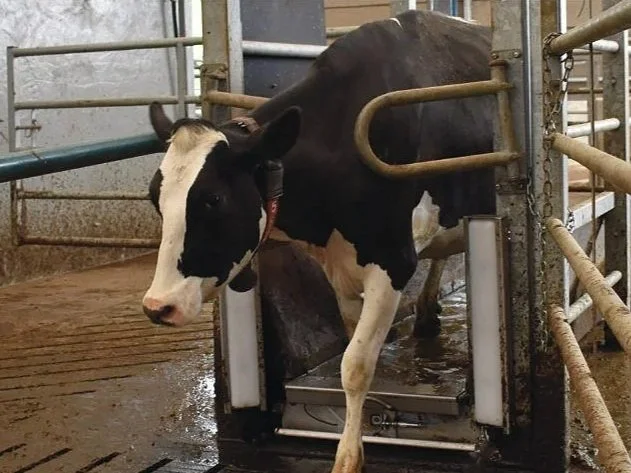
Footbaths. A Hoofcount has two chemical pumps, so it can run different products on different days without anybody carrying a drum across the yard. Buying the bath and the chemical from two suppliers is how a farm ends up with a good product on the wrong days.
Floors. Feet stand in the passage for most of the day and go through a bath for a few seconds. If the scraping only happens when somebody has time, chemical is being asked to do the scraper’s job, and the farm spends more every year to stand still.
Plant and tank. When the wash is not coming clean, the cause is the chemical, the water or the machine — and the person who can tell you which is the one who services the tank and the plant. Nobody has to be blamed down a phone line.
The Law Asks You to Design the Risk Out, Not Glove Up
Dairy chemicals are strong acids and strong alkalis, and the dairy is the one building on the farm where somebody handles both every day.
HSE put it plainly: “The law requires that employers assess and control the risks from hazardous substances.” That is COSHH, and the part most farms get backwards is the order it asks for. Personal protective equipment comes last, not first — HSE describe it as a control to use “only as a last resort”.
Can you avoid it entirely?
The first question COSHH asks is whether the job can be done without the substance, or with a milder one. On a dairy the honest answer is often no — but it is worth asking before assuming.
Design and dose without handling
Automatic dosing takes the drum out of somebody's hands altogether. It is the single biggest safety improvement available in most dairies and it usually pays for itself in accuracy alone.
Store acid and alkali apart
Separately, secured, off the floor, out of the frost, and never where they can be knocked into each other. Never mix them — the label says so for a reason and so does the safety data sheet.
Read the safety data sheet
Every product has one and your supplier must provide it. It carries the handling, storage, first aid and spillage detail, and it is the document a COSHH assessment is built from.
Water, eyewash and ventilation
Running water where the chemicals are used, an eyewash that is in date, and air movement in the dairy. These are cheap and they are what turns an accident into an inconvenience.
Then the gloves
Gauntlets, goggles and an apron that actually get worn, and training so the relief milker knows what is in the drum. Last in the order, not first, and never instead of the other five.
We do not publish dilutions, contact times or mixing instructions on a web page. Those live on the product label and in its safety data sheet, which is where they are legally required to be and where they are kept up to date. Ask us for the sheet and we will send it.
Counter, Lorry or Engineer
Dairy hygiene is one of the few things McCaskie sell down all three routes, and which suits you is mostly about pack size.
Over the counter
Small packs and the everyday lines at Ayr, Kinross, Lanark & Stirling. If you are passing, it is on the shelf.
Rep and delivery
Drums and bulk go out on our own lorry, ordered through your field sales rep. Every rep is a qualified SQP.
With the engineers
01786 474 481 or service@mccaskie.co.uk — for hygiene that goes with a plant we service, brought out on the next visit.
If the wash has stopped coming clean, that is a service call as much as a product question. Service and call-out runs twenty-four hours a day.
Dairy Hygiene Questions
What are the legal limits for raw milk?
Raw cows' milk must meet a plate count at 30°C of no more than 100,000 per ml and a somatic cell count of no more than 400,000 per ml. Both are Regulation (EC) No 853/2004, Annex III, Section IX, as retained in UK law, and both are judged as rolling geometric averages — two months for plate count, three for cell count — rather than on a single sample.
Why does one bad sample matter so much?
Because it is not judged on its own. Both limits are rolling geometric averages, so a bad result sits in your figure for the next two or three months and drags everything after it. By the time the average looks wrong the week that caused it is long past. That is the argument for hygiene being a routine rather than a reaction.
Why is my plate count creeping up?
Most often the wash rather than the cows — a wash running too cool, too short, or with milkstone already built up in the lines giving bacteria somewhere to live. It can also be the bulk tank rather than the plant. The useful thing about buying from the people who service the plant is that somebody can tell you which, instead of selling you a different drum.
What dairy hygiene products do you stock?
Teat dips and sprays, plant detergents and acid descalers, bulk tank wash, robot-specific lines and footbath products — the Downland range, with Deosan and the other names you already ask for alongside it. What suits your farm depends on your water, your plant and your cell counts, which is a conversation rather than a list.
Can I use parlour chemical in a robot?
It is a false economy. A robot washes itself on a cycle designed around products formulated for it, and parlour chemical used at a guess is how a farm ends up with a wash problem and an expensive callout. Downland carry robot lines and so do the specialist names. And as the leading Fullwood dealer in Scotland we service robots as well as supplying the chemical, so if your robot is one of ours, the people selling you the wash are the people who service it.
What does COSHH require me to do about dairy chemicals?
HSE state that the law requires employers to assess and control the risks from hazardous substances. The order matters: eliminate or substitute first, then engineering controls such as automatic dosing, then limiting exposure and good housekeeping — and personal protective equipment only as a last resort. Most farms start with gloves, which is the bottom of the list rather than the top.
How should I store dairy chemicals?
Acid and alkali separately, secured, off the floor, out of the frost, and never where one can be knocked into the other. Never mix them. Keep the safety data sheet for every product to hand — it carries the handling, storage, first aid and spillage detail and it is what a COSHH assessment is built from. Ask us and we will send you the sheet.
What strength should I use?
We do not publish dilutions, contact times or mixing instructions on a web page. They are on the product label and in the safety data sheet, which is where they are legally required to be and where they stay up to date. For footbath protocols in particular, that is a conversation for your vet or your hoof trimmer.